


Courtesy of the Artist and Pace Gallery
Photo: Roman März
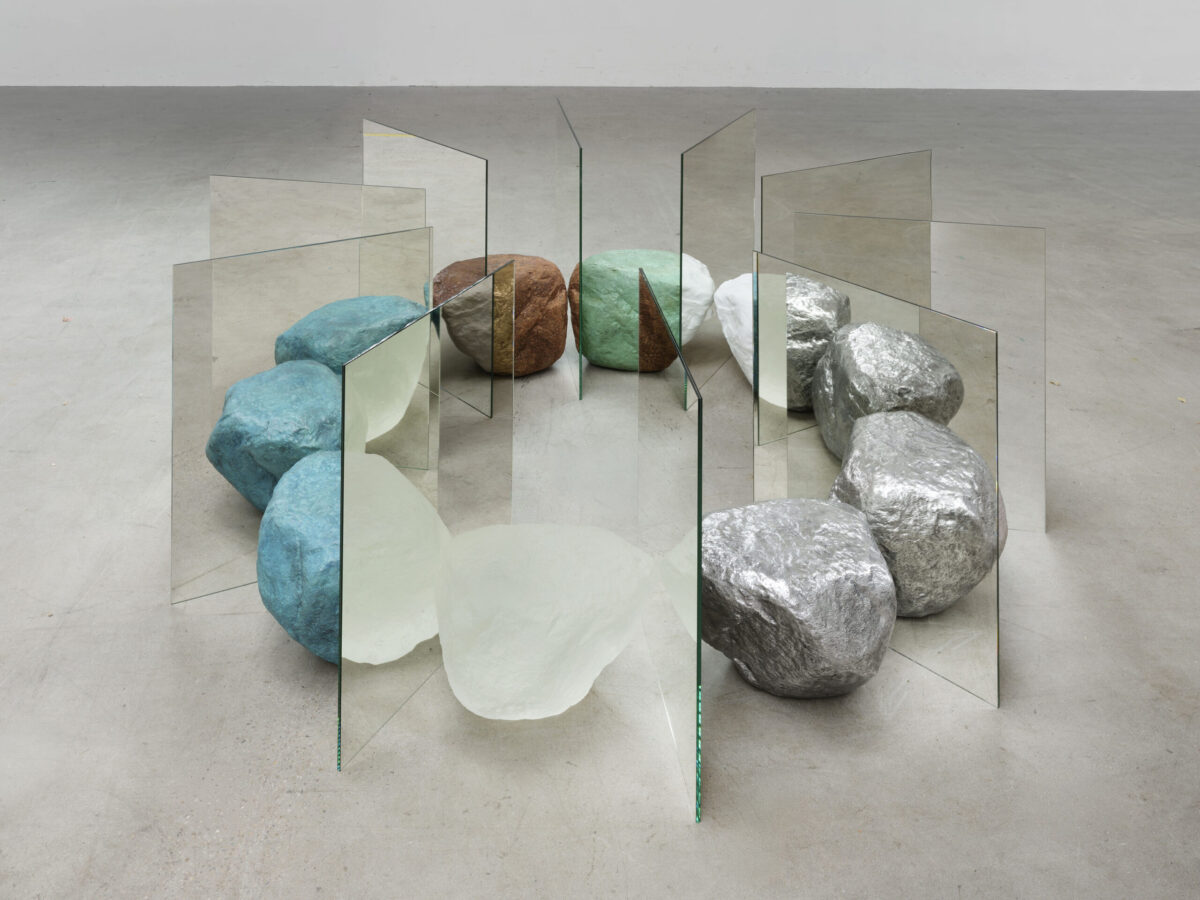
Alicja Kwade Ad Idem Aliter X
Installation
Information
10/31(Sat) 10:00 - 11/1(Sun) 22:00
Roppongi Hills 66 Plaza
Free
Detail
The work explores the interplay between being and hiding. Ten “stones” of identical shape, yet made from different materials, are arranged in a circle intersected by two-sided mirrors. As these doppelgängers lie next to one another, the function of the mirrored glass depends on the viewer’s position: it may appear either as a reflective surface or as a transparent pane, confronting one stone with its double. The glass can conceal part of one object while simultaneously completing it through the mirrored reflection of the corresponding part of the other. Depending on the angle from which it is viewed, the work reveals different versions of reality, questioning both our perceptual habits and fundamental physical laws. It creates a continuum of parallel forms of being while simultaneously exposing the limits of our perception. The viewer is always part of the very system they seek to observe, inevitably circling back to its inherent limitations. Rather than arriving at a final conclusion about reality, the work unfolds multiple possibilities for understanding it, without ever allowing one to escape this circulus in probando.
Map
Artist
Alicja Kwade
Alicja Kwade (b. 1979, Katowice, Poland) investigates and questions universally accepted notions of space, time, science, and philosophy by breaking down frames of perception in her work. Kwade’s multifaceted practice spans sculpture, installation, video, and photography. She utilizes quotidian and found objects such as rocks, mirrors, lamps, and clocks to explore profound ideas about the fabric of reality. Kwade’s use of elements such as copper, iron, human-made plastics, and recycled materials reflects her interest in both physics and chemistry, using art to bring core concepts together and examine the phenomena of the physical world. Her works often utilize the alchemical properties of her chosen materials to reveal the nature of the systems we use to understand the world—such as those for marking time or uncovering the origins of the universe—distilling complex ideas through form, material, and composition. Through her practice, Kwade examines planetary systems, molecular compositions, and mathematical frameworks, challenging conventional modes of thinking and exploring both the physical and metaphysical. While her work is often associated with Minimalism, Kwade approaches her practice with an eye toward Conceptual art.